FREE RESOURCE • SECTION 48E
Pre-Construction Compliance Checklist for Section 48E Projects
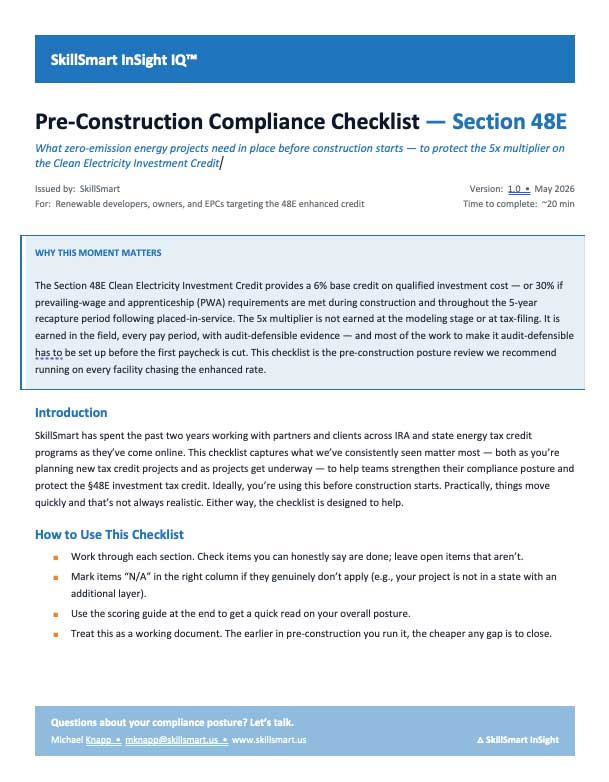
What zero-emission energy projects need in place before construction starts — to protect the 5x multiplier on the Clean Electricity Investment Credit.


FREE RESOURCE • SECTION 48E
What zero-emission energy projects need in place before construction starts — to protect the 5x multiplier on the Clean Electricity Investment Credit.
WHY THIS MOMENT MATTERS
The Section 48E Clean Electricity Investment Credit provides a 6% base credit on qualified investment cost — or 30% if prevailing-wage and apprenticeship (PWA) requirements are met during construction and throughout the 5-year recapture period following placed-in-service. The 5x multiplier is not earned at the modeling stage or at tax-filing. It is earned in the field, every pay period, with audit-defensible evidence — and most of the work to make it audit-defensible has to be set up before the first paycheck is cut. This checklist is the pre-construction posture review we recommend running on every facility chasing the enhanced rate.
A NOTE ON SCOPE
This checklist covers the pre-construction setup of PWA compliance for the Section 48E Clean Electricity Investment Credit — the foundation that earns the 5x multiplier at the time of placed-in-service. PWA obligations continue during the 5-year recapture period following placed-in-service whenever alteration or repair work is performed on the facility. That recapture-period compliance is covered in our companion 48E Recapture-Period Compliance Checklist. This document also does not cover the separate Domestic Content or Energy Communities bonus adders, the §6418 transfer mechanics, the §45Y PTC analogue, or the §45Q/§45V/§45U credits. Each of those has its own setup work.
SkillSmart has spent the past two years working with partners and clients across IRA and state energy tax credit programs as they’ve come online. This checklist captures what we’ve consistently seen matter most — both as you’re planning new tax credit projects and as projects get underway — to help teams strengthen their compliance posture and protect the §48E investment tax credit.
Ideally, you’re using this before construction starts. Practically, things move quickly and that’s not always realistic. Either way, the checklist is designed to help.
SECTION A
Goal: ensure the project has the right wage determinations on file and that coverage scope is unambiguous before any worker is on the clock.
SECTION B
Goal: meet the labor-hour percentage, the daily ratio, and the participation requirement, with documented Good Faith Effort if apprentices aren’t available.
SECTION C
Goal: every contractor and sub at every tier knows they are on a PWA project, has the right contract language, and is delivering the right records.
SECTION D
Goal: produce audit-ready records, held in the taxpayer’s name, in a form that can be retrieved quickly and traced from a single hour of labor to the credit claim.
PRE-CONSTRUCTION COMPLIANCE
InSight IQ manages wage determinations, contractor onboarding, apprentice ratios, and audit-ready records from the first paycheck — so the 5x multiplier is defensible at placed-in-service. See how it works.
SECTION E
Goal: catch underpayments and ratio shortfalls early, cure them within the regulatory window, and document the cure so an auditor sees a working program rather than a failure.
SECTION F
Goal: identify state-level prevailing-wage and apprenticeship layers that operate independently of the IRA, and make sure the project is paying and reporting to whichever standard is higher.
SECTION G
Goal: when the §48E credit is claimed at placed-in-service, the labor evidence ties cleanly to the qualified facility, and the certification withstands review.
SECTION H
Goal: align your compliance posture with what investors, transferees, or insurers will require — and decide deliberately whether to keep monitoring in-house, hire a third party, or carry tax-credit insurance.
SECTION I
Goal: when the facility is placed in service and the §48E credit is claimed, the compliance program survives intact and is positioned to protect the credit from recapture across the 5-year recapture period. PWA obligations do not end at COD — they continue for 5 years.
IF YOU’RE ALREADY IN CONSTRUCTION
If you’re reading this with mobilization already complete, focus first on records remediation: pull the last 90 days of certified payrolls and apprenticeship records, identify gaps, and cure underpayments retroactively. Underpayments can still be cured up to the point the credit is claimed — and a documented self-discovery cure is materially better evidence than an auditor-discovered failure. Then turn back to this checklist and address structural items (Sections C, D, E) so the next 90 days are clean.
SELF-ASSESSMENT SCORE
Tally the items you checked across all sections (about 40 in total). Use the bands below as a directional read — they are not a substitute for legal or tax advice.
Audit-ready posture. Tighten any open state-stack or tax-equity items.
Strong posture. Identify the lowest-scoring section and close gaps in the next 30 days.
Moderate exposure. Compliance program is partially in place but has structural gaps. Prioritize Sections A, B, and D.
High risk. The 5x multiplier is materially exposed. Treat as a near-term remediation project before further construction milestones.
INSTANT DEMO
Click through InSight IQ yourself. No form. No commitment. Watch wage determinations apply, vendor compliance track, and audit packages generate in real time.
✓ Wage Determinations ✓ Contractor Onboarding ✓ Apprentice Ratios ✓ Audit Packages
Prefer a guided walkthrough with a compliance specialist? Request a live demo →
FAQ
The §48E Clean Electricity Investment Credit provides a 6% base credit on qualified investment cost, which increases 5x to 30% when prevailing-wage and apprenticeship (PWA) requirements are met during construction and throughout the 5-year recapture period. Earning that multiplier requires audit-defensible labor records, most of which must be set up before construction begins.
Before the first worker is on the clock. Wage determinations must be on file, contracts must contain PWA flow-down language, apprenticeship outreach must be underway, and recordkeeping must be operational from the first pay period. Setting these up retroactively is far harder and weaker evidence at audit.
12.5% of total labor hours for facilities that began construction in 2023, and 15% for those beginning construction in 2024 or later. There is also a daily journey-to-apprentice ratio and a participation requirement for every contractor with 4 or more employees on covered work. If apprentices aren’t available, a documented Good Faith Effort is required.
The taxpayer claiming the credit must hold audit-ready records in its own name and possession. If a contractor folds or refuses to produce records at audit, the taxpayer is still on the hook for the credit. Collect weekly certified payrolls from every covered contractor at every tier, not just the GC.
Often, yes. Many states — California, Illinois, New York, and others — impose their own prevailing-wage and apprenticeship layers that operate independently of the IRA. The rule of thumb: pay whichever standard is higher and report under whichever standards apply, documenting which rule controls.
No. Focus first on records remediation: pull the last 90 days of certified payrolls and apprenticeship records, identify gaps, and cure underpayments retroactively. Underpayments can be cured up to the point the credit is claimed, and a self-discovered cure is materially stronger evidence than an auditor-discovered failure.
SkillSmart’s InSight IQ platform sets up the full compliance foundation: wage determination management, contractor onboarding with PWA flow-down, per-trade daily apprentice ratio tracking, certified payroll collection from every tier, cure management, and an audit-ready records system held in the taxpayer’s name and linked to the §48E credit claim. Every customer gets a dedicated compliance specialist.
Talk to a compliance lead who has helped configure 48E programs for renewable developers, owners, and EPCs.
30 min
Free pre-construction posture review
Whether you’re scoping your first 48E project or standardizing compliance across a portfolio, a 30-minute call with a compliance lead can help you close the gaps that matter most before construction starts.
Michael Knapp • mknapp@skillsmart.us
ABOUT SKILLSMART
SkillSmart is a wage-compliance system of record purpose-built for prevailing-wage and Davis-Bacon work, federal and state, and built simply enough that you don’t need to hire a consultant to run it. For specialty consulting firms running their own monitoring practices, SkillSmart is the operating system they can run their practice on.
This checklist is intended as an educational and operational tool for project teams scoping pre-construction compliance posture for the Section 48E Clean Electricity Investment Credit. It is not legal, tax, or accounting advice. Specific compliance obligations depend on facility location, scope, construction-start date, contractual structure, and other facts that should be reviewed with qualified counsel and a qualified tax advisor. Regulations and guidance under the Inflation Reduction Act, the One Big Beautiful Bill Act of 2025, and state-level frameworks continue to evolve; verify current rules before relying on any item in this document.