Introducing the InSight Dashboard: Clearer Compliance at a Glance

Managing prevailing wage and workforce compliance often means juggling multiple data points across projects, teams, and timelines. Critical issues can be buried in reports, discovered too late, or require multiple clicks just to understand what’s happening.

The new InSight Dashboard was designed to change that.

It brings your most important compliance data into a single, easy-to-understand view—so teams can check in on project health faster, identify issues sooner, and focus on action instead of investigation.

Learn More

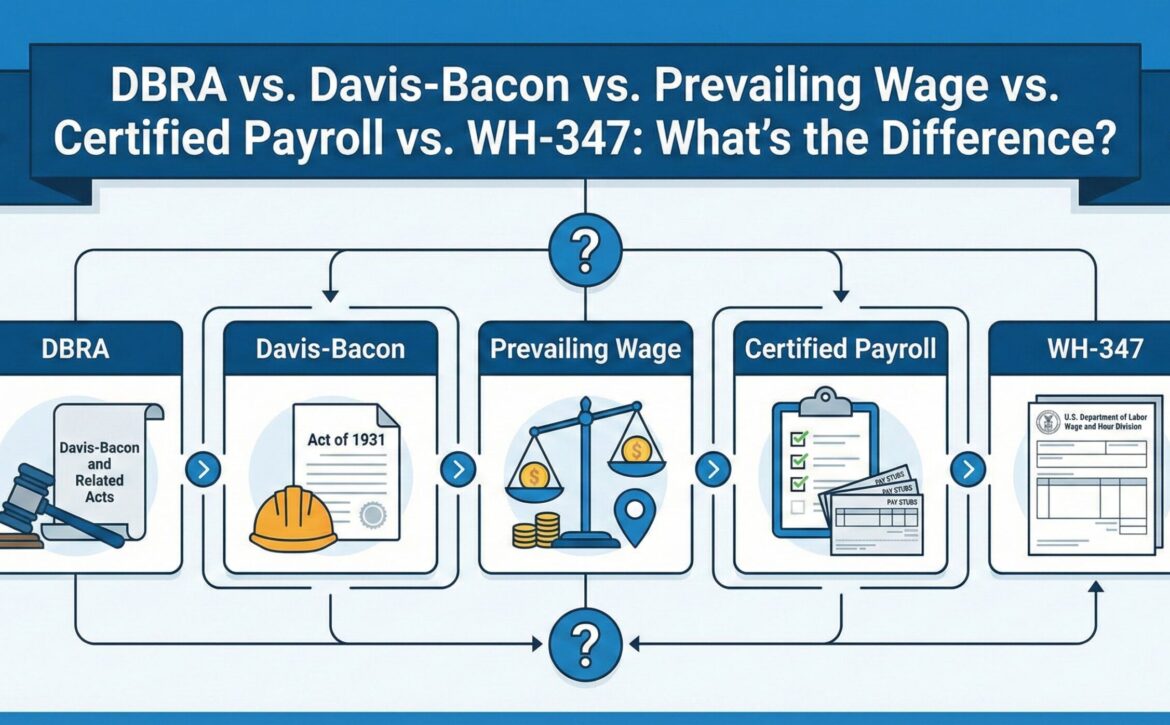
DBRA vs. Davis-Bacon vs. Prevailing Wage vs. Certified Payroll vs. WH-347: What’s the Difference?

If you work on federally funded construction, federal tax credit, or federal loan projects, you’ve probably heard these terms used and not really known if they’re the same or different:

  • DBRA
  • Davis-Bacon
  • Prevailing Wage
  • Certified Payroll
  • WH-347
  • New WH-347

Contractors, subs, payroll administrators, and even public agencies mix these up constantly—and that confusion leads to missed requirements, rejected certified payrolls, and sometimes back-wage findings.

This guide breaks each term down (in normal language) and shows how they fit together so you can stay compliant without the headache.


The Simple Hierarchy: How These Terms Connect

Think of the compliance ecosystem like this:

DBRA → Davis-Bacon → Prevailing Wage Requirements → Certified Payroll → WH-347 Form

  • DBRA (Davis-Bacon and Related Acts) = the umbrella laws
  • Davis-Bacon = the core act
  • Prevailing wage = the wage + fringe rates you must pay
  • Certified payroll = the weekly reporting proving that you complied
  • WH-347 = one optional form you can use for that reporting

Once you see this structure, hopefully everything gets clearer.


The umbrella laws that create the requirements

The Davis-Bacon and Related Acts (DBRA) are a group of federal laws requiring contractors and subcontractors on federally funded or federally assisted construction projects to pay prevailing wages to workers.

DBRA is broader than just federal construction. It includes dozens of “related acts” connected to agencies like:

  • HUD
  • DOT
  • DOE
  • EPA
  • USDA

If your project uses federal funds—even partially—DBRA likely applies.

Why People Confuse It

DBRA is the legal framework, but many project documents simply say “Davis-Bacon.” That’s technically incorrect, but common.


The Davis-Bacon Act

The core law inside DBRA

The Davis-Bacon Act (DBA) is the main statute requiring payment of prevailing wages on federal construction projects over $2,000.

How It’s Different From DBRA

  • DBA covers federal construction only.
  • DBRA includes Davis-Bacon plus all the other acts that apply Davis-Bacon rules to federally assisted projects.

In short: DBRA is the umbrella; Davis-Bacon is the anchor.


Prevailing Wage

The wage + fringe rate you must pay workers

Prevailing wage isn’t a law—it’s the required wage standard set by the U.S. Department of Labor.

A prevailing wage rate is based on three things:

  1. Trade/classification (Electrician, Laborer, Operator, etc.)
  2. County where the work is performed
  3. The official wage determination issued by the Department of Labor

A prevailing wage is always two parts:

  • Base hourly rate
  • Fringe rate (cash or bona fide fringe benefits)

Why This Gets Confused

People often refer to the entire Davis-Bacon compliance process as “prevailing wage,” but it’s only the rate, not the reporting or the certification.


Certified Payroll

The weekly proof of compliance

Certified payroll is the weekly reporting contractors and subcontractors must submit to show they paid workers correctly.

Every certified payroll report includes:

  • Worker and classification details
  • Hours worked (regular, OT, weekend)
  • Base rate + fringe allocation
  • Gross pay
  • Deductions
  • A signed Statement of Compliance

Why People Confuse It

Many assume “certified payroll” = “WH-347,” but the WH-347 is just one version of a certified payroll report. Different agencies, including at the state and local levels, often have their own formats or require electronic submission portals.


The WH-347 Form

DOL’s optional certified payroll form

The WH-347 is a standardized Department of Labor form contractors can use to submit certified payroll. It includes the Statement of Compliance and all required reporting fields.

Important

The WH-347 is optional unless a contracting agency specifically mandates it.

Many primes and subs still prefer it because it’s simple and universally recognized.


Why Using the WH-347 Can Be a Benefit Compared to Other Certified Payroll Formats

Even though certified payroll can be submitted in multiple formats, the WH-347 offers several practical advantages—especially for subcontractors and smaller contractors.

1. Auditors Immediately Recognize It

Because the WH-347 is a DOL-issued format:

  • Auditors know exactly where to find data
  • Reviewers don’t need explanations
  • There’s less back-and-forth during reviews

It reduces friction during audits and closeout.

2. It Eliminates Guesswork

The WH-347 guides you through:

  • Workers
  • Classifications
  • Hours
  • Rates
  • Fringes
  • Deductions
  • Compliance signature

There’s no reinventing the wheel each week.

3. It Works on Most Projects Without Proprietary Portals

If the agency does not require LCPTracker, eCMS, B2GNow, or a custom spreadsheet, WH-347s are almost always acceptable.

Consistency matters—especially for subs working on multiple small federal projects each year.

4. It Reduces the Risk of Missing Required Fields

Custom contractor or agency forms vary widely. WH-347s do not.

Using a WH-347 ensures you don’t miss critical fields like:

  • Fringe allocation
  • Classification adjustments
  • Total hourly compensation breakdown
  • Statement of Compliance wording

5. Subcontractor-Friendly

Subs often don’t have a dedicated compliance officer. WH-347s:

  • Are simple
  • Are repeatable
  • Require minimal software or training

For many teams, that simplicity is the difference between compliance and chaos.

6. Faster Prime Contractor Review

Primes reviewing dozens of subcontractors prefer standardized WH-347s because:

  • Errors stand out immediately
  • Roll-up reporting is easier
  • Review cycles shorten

When everyone follows the same structure, fewer payrolls bounce back.

7. Clean Archiving for Closeout

WH-347s produce predictable, high-quality documentation that:

  • Stores cleanly
  • Exports easily
  • Helps for multi-year or multi-agency audits

This saves hours during closeout and post-award reviews.

Bottom Line

WH-347s keep compliance simple, predictable, and audit-friendly. They remain the most contractor-friendly certified payroll format available.


The New WH-347 (2024–2025 Update)

Updated to reflect the 2023 Davis-Bacon Final Rule

The Department of Labor recently updated the WH-347 to align with modern Davis-Bacon regulations.

What Changed

  • New fringe reporting structure
  • Updated Statement of Compliance language
  • Clarified classification and hours categories

What Stayed the Same

  • Still optional
  • Still recognized widely
  • Still designed for weekly reporting

Many contractors are unaware the form changed, which is why tools like InSight IQ help ensure you’re using the correct version.


Quick Comparison Table

Term What It Is Applies To Why It’s Confused
DBRA Group of laws Federally funded/assisted construction Sounds like a program rather than legislation
Davis-Bacon Core act requiring prevailing wages Federal construction Used as shorthand for all DBRA
Prevailing Wage Required wage + fringe Fed & state projects Mistaken for the entire compliance process
Certified Payroll Weekly compliance report Contractors & subs Mistaken for WH-347
WH-347 Optional DOL certified payroll form Projects without proprietary systems Seen as “the required form”
New WH-347 Updated DOL version DBA/DBRA projects Contractors unaware the form changed


How InSight IQ Helps Contractors Do This Without the Stress

Most smaller contractors don’t need a bloated enterprise platform—they need something simple and accurate. That’s why we created InSight IQ, a streamlined system designed specifically for prevailing wage compliance.

With InSight IQ, you can:

  • Automatically interpret wage determinations
  • Track multiple classifications correctly
  • Generate compliant WH-347s and agency-specific forms
  • Catch errors before they reach the prime or agency
  • Maintain a clean audit trail
  • Reduce risk of back-wages and penalties
  • InSight IQ aids in tracking apprentices on the job for the new WH-347

Whether you submit WH-347s or use an agency portal, InSight IQ makes certified payroll easier, faster, and more accurate.


Conclusion

These terms get mixed up constantly, and for good reason—they’re all connected. But once you understand the hierarchy, Davis-Bacon compliance becomes much more manageable.

  • DBRA and Davis-Bacon create the rules
  • Prevailing wages set the rates
  • Certified payroll proves compliance
  • The WH-347 is just one (very helpful) way to report it

If you want help navigating these requirements—or want to streamline certified payroll reporting—view our instant demo of InSight IQ.

 

FREQUENTLY ASKED QUESTIONS ABOUT PREVAILING WAGE, DBRA, DAVIS-BACON, WH-347 AND CERTIFIED PAYROLL

1. Is DBRA the same thing as Davis-Bacon?

No. Davis-Bacon is one law inside the broader DBRA framework. DBRA refers to Davis-Bacon plus dozens of related acts that apply prevailing wage requirements to federally assisted projects (HUD, DOT, EPA, DOE, etc.).

2. Do all federally funded projects require Davis-Bacon compliance?

If federal funds are used for construction, maintenance, or repair work, prevailing wage requirements almost always apply. Some exceptions exist, but the project owner or agency typically specifies DBRA applicability in the contract documents.

3. Is the WH-347 form required for certified payroll?

No. The WH-347 is optional unless a contracting agency mandates it. Contractors can use their own format or a compliance system like InSight IQ, as long as all required data fields are included.

4. What’s the difference between “prevailing wage” and “certified payroll”?

  • Prevailing wage = the hourly rate + fringe that workers must be paid.

  • Certified payroll = the weekly report proving workers were paid correctly.

One is the wage requirement; the other is the documentation.

5. When should contractors use the WH-347 form?

  • You want a standardized, audit-friendly format

  • The agency allows it or doesn’t specify a format

  • There is no proprietary reporting portal

  • You need a consistent form across multiple small projects

It’s especially helpful for subcontractors without dedicated compliance staff.

6. What changed with the new WH-347 in 2024–2025?

The updated form reflects changes from the 2023 Davis-Bacon Final Rule, including:

  • A revised fringe reporting layout

  • Updated Statement of Compliance wording

  • Clearer worker classification sections

It remains optional.

7. What happens if you submit certified payroll incorrectly?

Common consequences include:

  • Rejected payrolls

  • Delayed payment

  • Required resubmissions

  • DOL findings that may result in back-wages or penalties

Consistently accurate certified payroll reduces your audit risk significantly.

8. How can InSight IQ help with Davis-Bacon and certified payroll?

InSight IQ automates the most error-prone parts of compliance, including:

  • Interpreting wage determinations

  • Breaking out fringes properly

  • Generating WH-347s and agency-specific formats

  • Tracking classifications

  • Surfacing errors before submission

  • Automates payroll periods eliminating gaps and overlaps in reporting periods

It eliminates manual guesswork and keeps contractors compliant with less effort.

Learn More

Simplifying SCA Compliance: How to Meet Service Contract Act Prevailing Wage Requirements with Ease

Looking for modern prevailing wage compliance software? Discover how InSight IQ simplifies PWA tracking, certified payroll reporting, and tax credit compliance with user-friendly tools built for today’s energy and construction projects.

Learn More

Prevailing Wage Laws Are Over a Century Old — Your Compliance Software Shouldn’t Be

Looking for modern prevailing wage compliance software? Discover how InSight IQ simplifies PWA tracking, certified payroll reporting, and tax credit compliance with user-friendly tools built for today’s energy and construction projects.

Learn More

How to Meet Prevailing Wage and Apprenticeship Requirements for IRA Tax Credit Eligibility

Maximize your IRA energy tax credits by understanding and complying with Prevailing Wage & Apprenticeship requirements. Discover tools, FAQs, and tips to streamline compliance.

Learn More

Emerging Trends in Prevailing Wage Projects – Ensure that You’re Prepared

Explore the emerging trends in prevailing wage and apprenticeship (PWA) projects, from green energy initiatives to advanced compliance tools. Discover how SkillSmart’s InSight IQ simplifies wage calculations, certified payroll reporting, and apprenticeship tracking to ensure compliance and secure tax benefits. Stay ahead of evolving policies and workforce challenges.

Learn More

You Have Options! Modern Technology for Simplifying Your Tax Credit and Prevailing Wage Compliance

Maximize tax credits and simplify compliance for renewable energy projects with SkillSmart’s InSight IQ. Our modern, adaptable platform streamlines prevailing wage and apprenticeship tracking, automates reporting, and provides full data visibility, ensuring your projects meet evolving regulatory requirements. Empower your team with efficient, real-time compliance management designed for today’s energy landscape.

Learn More

SkillSmart Achieves SOC2 Compliance: Supporting and Protecting Our Clients

SkillSmart is proud to announce successful completion of the SOC 2 Type II Audit, ensuring our clients benefit from top-tier data security and compliance. This achievement reaffirms our commitment to safeguarding client data with best-in-class technology and services, demonstrating our dedication to security, compliance, and community impact.

Learn More

InSight Minute: Can You Meet the Prevailing Wage Requirements for your Project?

There are a many new federal programs that provide funding or economic incentives like tax credits, grants and loans to organizations in many different industries that are vital to our economy and infrastructure.

A key requirement that must be met for many of these programs is to ensure that workers on the projects are receiving a prevailing wage. Since this is a new concept for a lot of these industries, representatives are seeking to better understand the requirements and concept of prevailing wage.

According to the U.S Department of Labor, prevailing wage is defined as the average wage paid to similarly employed workers in a specific occupation in the geographic area of intended employment.  While this may be a new concept for you, it doesn’t have to be difficult to address and there are tools that can help you manage this easily and effectively.

In this month’s InSight Minute we’re going to discuss some of the many different types of programs that may be receiving this increased investment, and how to more easily manage prevailing wage, and other workforce requirements like tracking of apprentices.

As you review the various programs that may affect you, know that no matter which industry you may be in, you can reach out to SkillSmart.

The InSight IQ platform can be easily implemented to allow you to track prevailing wage requirements for your vendors and subcontractors, as well as on work that is undertaken by your employees.

Following are some of the programs and industries that may require tracking of prevailing wage and apprentices.

The CHIPS and Science Act invests $280 billion to bolster US semiconductor capacity, catalyze R&D, and create regional high-tech hubs and a bigger, more inclusive STEM workforce. In an effort to increase the amount of semi-conductors manufactured in the US to support these activites, the federal government made a significant investment in the form of grants, loans, and loan guarantees support various organizations in this important sector.  Following are some of the impacted industries.

  • Semiconductor manufacturing – Includes subsidies for building new fabrication plants and expanding domestic production capacity.
  • Telecommunications – Funding to support 5G deployment and bolster supply chains.
  • Automotive – Investments in electrification and autonomous vehicles which rely on advanced semiconductors.
  • Defense – Research grants for developing specialized chips to meet national security needs.
  • Technology – Broad support for advancing semiconductor-enabled technologies like AI and quantum computing.

The Broadband Equity, Access, and Deployment (BEAD) Program, provides $42.45 billion to expand high-speed internet access by funding planning, infrastructure deployment and adoption programs throughout the U.S.

The Bipartisan Infrastructure Law supports a number of policies and programs that generally include eight broad areas—clean energy projects and infrastructure; manufacturing and industrial transformation; water; buildings and schools; fairness for workers and communities; community resilience; transportation; and methane and natural gas distribution.

It includes $550 billion in new federal infrastructure funding over five years to repair, rebuild, and modernize America’s bridges, transit systems, water infrastructure, and more. While more than half of the bill’s funding is for transportation infrastructure—including surface transportation, airports, zero-emissions school buses, electric vehicle (EV) charging, ports, public transit, railways, and more—it also provides significant funding for broadband, the power grid, water infrastructure, resilience, and legacy pollution.

The Inflation Reduction Act (IRA) is an approximately $740 billion package, with nearly $400 billion earmarked for energy and climate projects, and makes several clean energy tax incentives available to organizations that satisfy certain prevailing wage and apprenticeship requirements.

There is a provision that indicated projects had to “begin construction” by January 28, 2023 in order to be exempted from the prevailing wage and apprenticeship requirements, as determined under the existing begin-construction principles. So, most projects for organizations in the following areas that may be eligible for these tax incentives must likely meet the prevailing wage and apprentice requirements.

  • Clean Energy;
  • Clean Technology Manufacturing;
  • Industrial Transformation;
  • EV Deployment, Manufacturing, and Supply Chain;
  • Transmission;
  • Buildings;
  • Energy Transition for Workers and Communities; and
  • Resilient and Healthy Communities.

In general, an organization that meets the prevailing wage and apprenticeship requirements will multiply the base amount of the tax incentive (credit or deduction) by five. Increased credit and deduction amounts are available for taxpayers satisfying prevailing wage and apprenticeship requirements under the following sections of the Internal Revenue Code (Code):

  • Section 30C alternative fuel vehicle refueling property credit
  • Section 45 renewable electricity production credit
  • Section 45Q credit for carbon oxide sequestration
  • Section 45V credit for production of clean hydrogen
  • Section 45Y clean electricity production credit
  • Section 45Z clean fuel production credit
  • Section 48 energy credit
  • Section 48C qualifying advanced energy project credit
  • Section 48E clean electricity investment credit
  • Section 179D energy efficient commercial buildings deduction

Increased credit amounts are available for taxpayers satisfying prevailing wage requirements under:

  • Section 45L new energy efficient home credit (apprenticeship requirements do not apply)
  • Section 45U zero-emission nuclear power production credit (apprenticeship requirements do not apply)

SkillSmart’s InSight IQ technology becomes your ally in addressing prevailing wage requirements in any and all of these programs – streamlining data collection, monitoring, and reporting. Ensure your projects not only benefit the environment but also meet compliance standards effortlessly.

Fill out the form below to schedule a demo.

"*" indicates required fields

This field is for validation purposes and should be left unchanged.
Learn More

Prevailing Wage: The New Factor Impacting Energy Projects

Over the past two years, organizations in the energy sector have become increasingly aware of the concept of prevailing wage, which has arisen from the implementation of the Inflation Reduction Act (IRA), the Infrastructure Investment and Jobs Act (IIJA), as well as an increasing emphasis on this topic by jurisdictions and project owners. While it’s a fairly straightforward concept, many sectors within the industry are encountering it for the first time, leading to some unfamiliarity. Essentially, prevailing wage refers to the basic hourly rate of wages and benefits paid to similarly employed workers in a specific geographic area.

Now, more energy organizations are not only learning about prevailing wage but also finding themselves needing to take action. This is because certain funds, tax credits, and policies now hinge on ensuring prevailing wages are paid and that the associated information is documented and reported regularly. Traditionally, this requirement was mainly associated with construction projects, leaving many other sectors within the industry relatively untouched by such considerations.

Because prevailing wage requirements are becoming more prevalent, specifically in the energy sector, for new and existing energy operations and development projects, we will address two key points: Why meeting prevailing requirements is important; and How to effectively capture prevailing wage data, for compliance and cash flow from federal funding sources.


First, you might find yourself subject to prevailing wage requirements now, even if you haven’t encountered them before. This could happen because the project or organization you’re working with is now pursuing specific tax credits or financing that necessitates compliance. This change could apply retroactively, even to projects previously exempt. For instance, SkillSmart was brought onto a client’s EV battery manufacturing project, ongoing for nearly a year, only to find out that a recent project refinancing required all workers to meet, track, and submit prevailing wage . Working against a three week deadline, over 125 subcontractors and vendors were required to provide their prior-year information. Many initially dismissed it as an error until the project owner and general contractor clarified the situation.

Secondly, since other industry sectors have had to meet prevailing wage requirements previously, this is not a new concept, so there are tools that can help you, and you don’t have to go through this on your own.  That’s where SkillSmart can provide a solution. InSight, our highly configurable and easy-to-use software platform, is at the forefront of supporting our clients and partners in driving positive change and providing solutions to help project teams use their day-to-day data to meet expectations, internally and externally. Based on conversations during the prospecting stage, our team would recommend the following things to look for and specifically ask about during a demo.

  1. Ease of Use: Ensure the software is user-friendly, especially for subcontractors and vendors who will be submitting their information. A streamlined interface can save time and reduce errors in data submission.
  2. Tracking Multiple Tiers: Look for a solution that can capture information from every organization involved in your projects, whether they report directly to you or to one of your subcontractors. This ensures comprehensive compliance across all tiers of your supply chain.
  3. Scalability: Choose a platform that can grow with your business and support your expanding activities and projects. This flexibility ensures that the software remains effective as your operations evolve.
  4. Support: Confirm that the product offers adequate support for you, your team, subcontractors, and vendors at no additional cost. Access to timely assistance can resolve issues quickly and minimize disruptions to your workflow.

As we conclude, remember not to overlook the possibility of now being subject to prevailing wage requirements. Take the initiative to inquire with your client or project owner about any recent changes. Additionally, explore resources such as SkillSmart and tools like InSight, which can offer valuable assistance. You’re not alone in this journey; if you need guidance,  reach out to us. Our team is here to help you navigate through this new terrain.

Learn More